Cacio e Pepe vs. Carbonara: The Roman Emulsion Clash
A thermodynamic breakdown pitting Cacio e Pepe against Carbonara. We analyze starch gelatinisation, protein coagulation, and lipid-water emulsions.
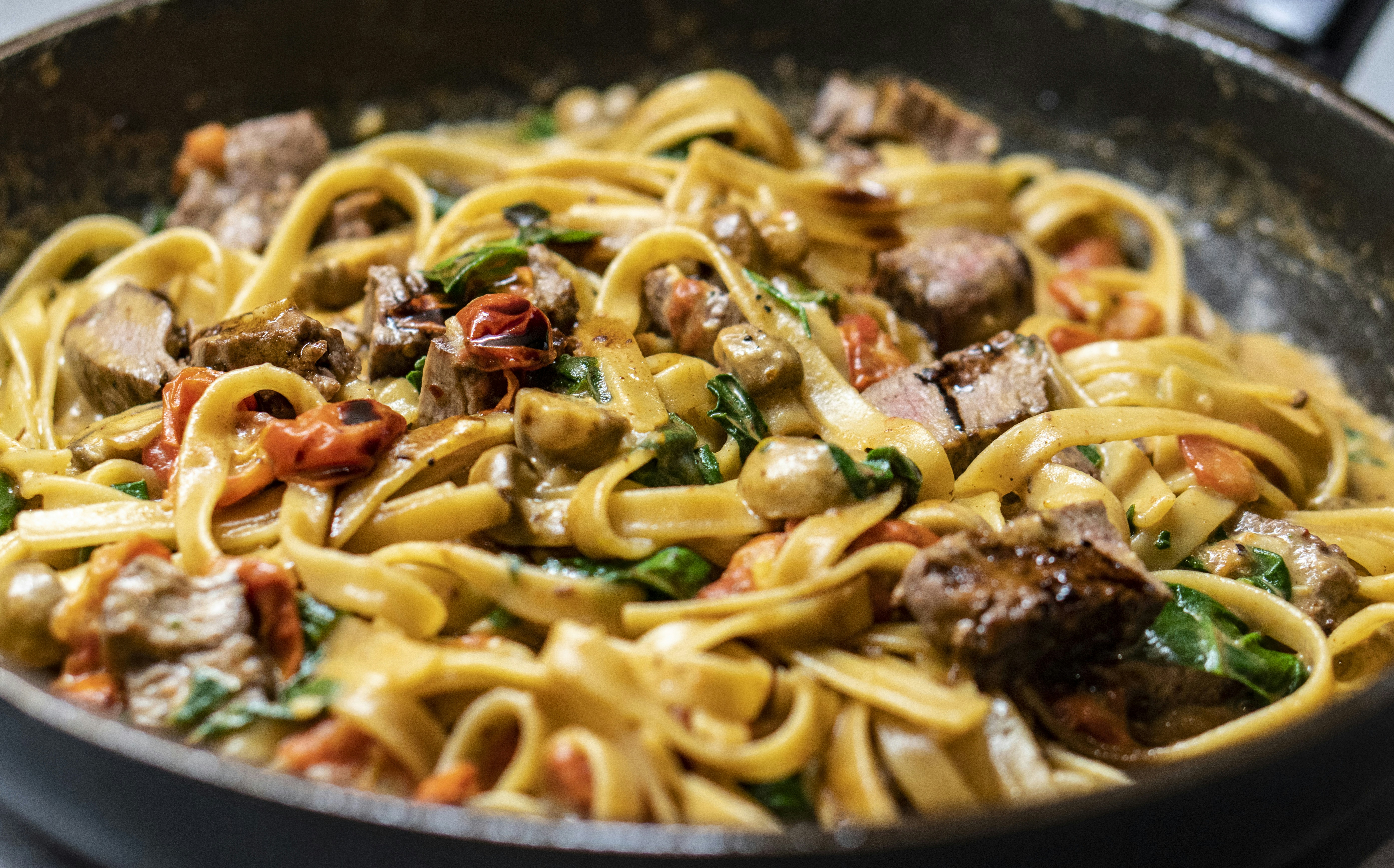
In the pantheon of Roman pasta, minimalism is not an aesthetic choice; it is a high-wire thermodynamic trial. Strip away heavy reductions, mirepoix, and cream, and what remains is an unforgiving arena governed strictly by the laws of physics and organic chemistry.
Tonight, inside the historic Colosseum of starch, two heavyweight iterations of the Roman pastoral canon step onto the canvas: the stripped-back, high-friction brawler Cacio e Pepe, and the richer, multi-phase tactical powerhouse Carbonara. Both rely on the marriage of Pecorino Romano, black pepper, and cooking water. Yet their internal mechanics diverge violently at the molecular level.
Let the bell ring.
Tale of the Tape: Thermodynamic & Chemical Profiles
| Metric | Cacio e Pepe | Carbonara |
|---|---|---|
| Primary Lipid Source | Sheep milk fat (Pecorino Romano) | Rendered pork fat (Guanciale) + Egg yolk lipids |
| Emulsifying Agent | Gelatinised pasta starch (Amylose/Amylopectin) | Lecithin (Phospholipids) + Starch |
| Critical Failure Threshold | 65°C (Casein agglomeration) | 68°C–73°C (Ovotransferrin/Yolk protein coagulation) |
| Viscosity Mechanism | High-shear aqueous starch suspension | Thermal protein setting + lipid-in-water suspension |
| Mechanical Shear Required | Extreme (Rapid panning/whisking) | Moderate (Residual heat folding) |
| Aromatic Vector | Piperine dissolved in warm cooking water | Piperine bloomed in rendered pork fat |
Fighter 1: Cacio e Pepe (The Naked Suspension)
Cacio e Pepe steps into the ring with nothing to hide behind. It consists of three variables: hydrated dried pasta (typically tonnarelli or spaghetti), finely microplaned Pecorino Romano, and coarsely cracked black pepper (Piper nigrum).
The Kinetic Mechanism
Cacio e Pepe is an extreme suspension problem. Hard sheep’s milk cheese is packed with casein proteins, water, and milk fats. When heated, the hydrophobic bonds within the casein micelles loosen, causing them to release fat. Without an intervening surfactant, these proteins undergo rapid syneresis: they cross-link into dense, rubbery strings while squeezing water and oil out into an unsightly pool.
To prevent this catastrophic separation, the cook leverages starch gelatinisation. Cooking pasta in a low volume of water concentrates liberated amylose and amylopectin molecules. When this starchy slurry is vigorously whipped into the cheese off the flame at precisely 55°C–62°C, the long-chain carbohydrates increase the viscosity of the continuous aqueous phase. The starch physically impedes the casein strands from colliding and contracting, suspending milk fats inside a delicate colloidal network.
The Weapon: Piperine Extraction
Cacio e Pepe blooms cracked peppercorns directly in a dry skillet or a shallow pool of starchy water. Heating the peppercorns thermalises the piperine alkaloid and volatile terpenes (such as pinene and limonene), delivering a dry, pungent heat that cuts directly through the salty, lipophilic density of the Pecorino.
Fighter 2: Carbonara (The Quad-Phase Emulsion)
Carbonara expands the ring, introducing rendered guanciale (cured pork jowl) and whole eggs or egg yolks to the fundamental matrix of cheese, pepper, and starch. It is structurally complex: a four-phase emulsion comprising solid proteins, liquid water, suspended starches, and melted fats.
The Kinetic Mechanism
Where Cacio e Pepe relies purely on carbohydrate mechanics to prevent curdling, Carbonara introduces nature’s premier biochemical surfactant: egg yolk lecithin.
Yolk solids are packed with amphiphilic phospholipids that feature both water-soluble heads and fat-soluble tails. When rendered guanciale fat is introduced to starchy cooking water and egg, the lecithin migrates to the lipid-water interface, lowering interfacial tension and forming sub-micron fat droplets that resist coalescence.
Simultaneously, the culinary arbiter must control the coagulation of egg proteins. Ovotransferrin sets at approximately 62°C–65°C, while yolk vitellin and live proteins cross-link near 68°C–70°C. Starch from the pasta water performs a double duty here: it acts as a molecular spacer between the egg proteins, elevating the thermal point at which the eggs will scramble into curds. This chemical shield affords a luxurious, velvety sauce that clings to the pasta through cohesive viscosity rather than unstable surface tension.
The Weapon: Maillard Complexity
Guanciale introduces the Maillard reaction. As the pork jowl renders over low-to-medium heat, sugars and amino acids form hundreds of flavor compounds: alkylpyrazines, furans, and savory sulfur notes. Blooming the cracked black pepper directly in the rendered pork fat extracts piperine into the lipid medium, softening its abrasive edge and distributing its heat evenly across the palate.
The Danger Zones: How They Break
Every champion has a glass jaw. In this arena, failure is binary and visible to the naked eye.
CACIO E PEPE BREAKDOWN:
[Excess Heat >65°C] -> Casein Denaturation -> Hydrophobic Contraction -> Clumped Rubber + Greasy Slurry

CARBONARA BREAKDOWN:
[Excess Heat >73°C] -> Ovalbumin/Vitellin Coagulation -> Irreversible Protein Cross-linking -> Scrambled Eggs- The Cacio Collapse: If the pasta water is added at rolling-boil temperatures (100°C), Pecorino’s casein matrices collapse instantaneously. The result is a floating, chewing-gum-like plug of proteins adrift in cloudy, greasy water. Rescuing this break requires mechanical immersion blending—an immediate disqualification in Roman ring craft.
- The Carbonara Curdling: If the pan retains too much thermal mass when the egg mixture is folded in, the egg proteins denature completely, forming hard, sulfurous curds. The dish transitions from a glossy, unctuous coat to pasta with scrambled eggs and bacon.
The Arbiter’s Verdict
Cacio e Pepe is an uncompromising showcase of purist technique. Executing it perfectly demands razor-sharp thermal awareness, flawless starch-water concentration, and intense mechanical agitation. When it succeeds, it is an astonishing demonstration of physics masquerading as dinner.
However, Carbonara is the superior culinary construction.
The addition of guanciale fat provides an essential lipid anchor that tames the sharp capsaicin-adjacent punch of piperine via fat-soluble extraction. More decisively, the presence of yolk lecithin introduces superior thermodynamic insurance. It constructs a richer, more structurally resilient emulsion that does not rely exclusively on brittle starch-casein spatial dynamics. Carbonara takes the volatile foundation of Cacio e Pepe, deepens its Maillard spectrum, and fortifies its molecular architecture into an undisputed masterpiece of Roman culinary science.