Penne vs Rigatoni: The Tubular Physics of Sauce Trapping
We put penne and rigatoni through hydrodynamics and surface-friction trials to determine the ultimate tubular vessel for sauce adhesion.
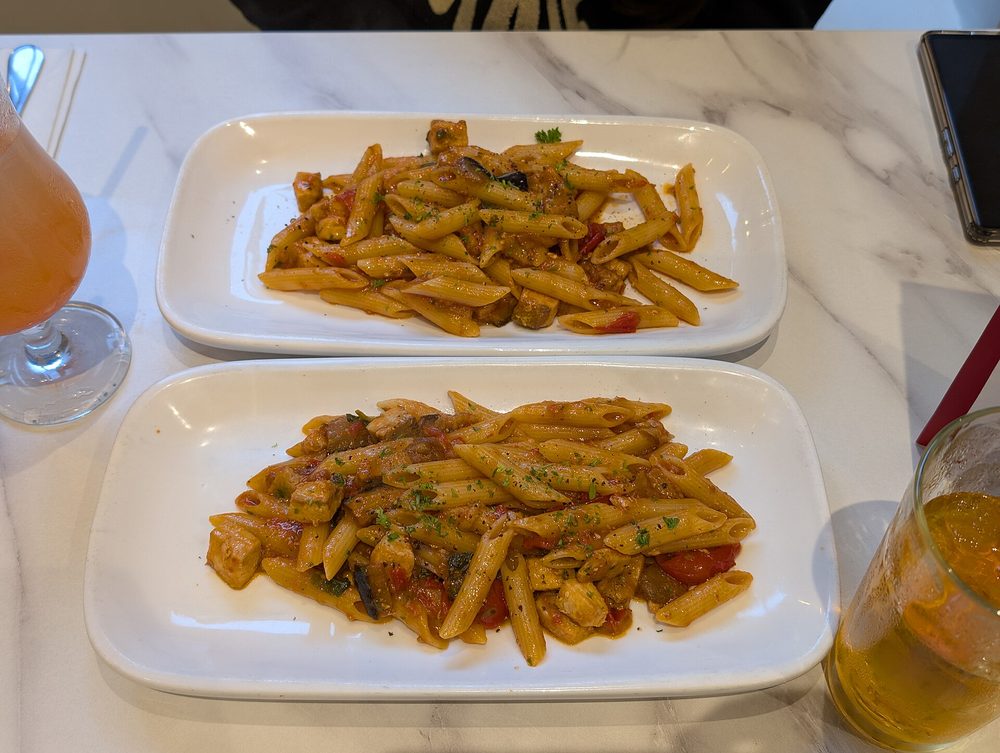
In the pantheon of extruded durum wheat, the extruded tube is the undisputed workhorse of the modern pasta arsenal. Yet between the bias-cut dart of penne and the cavernous, blunt-nosed barrel of rigatoni lies an ongoing dispute grounded in fluid mechanics, particulate capture, and surface metrology.
Home cooks frequently treat these two shapes as interchangeable extruded vessels. They are profoundly mistaken. The interaction between a cooked tube of pasta and an emulsion—whether a glossy cacio e pepe or a particulate-heavy ragù alla Bolognese—is dictated strictly by mathematical cross-sections, boundary-layer drag, and capillary forces. We strapped both shapes to the test bench to crown the ultimate champion of sauce transport.
Tale of the Tape: Geometry and Surface Metrology
To evaluate these contenders objectively, we must bypass culinary romance and examine their structural blueprints. Extrusion through traditional bronze dies (trafilata al bronzo) yields a microscopically pitted landscape of denatured protein and fractured starch granules, but macro-geometry controls the bulk volume of liquid and solids transported from plate to palate.
| Metric | Penne Rigate | Rigatoni |
|---|---|---|
| Typical Cut Angle | 45° (Acute Bevel) | 90° (Orthogonal) |
| Internal Diameter (Lumen) | 7.0 – 8.2 mm | 11.5 – 14.0 mm |
| Average Wall Thickness | 1.15 mm | 1.35 mm |
| Ridge Orientation | Spiral / Helical Longitudinal | Straight Longitudinal |
| Lumen Volume per Piece | ~0.95 cm³ | ~2.10 cm³ |
| Hydrodynamic Profile | Low drag, convergent flow | High drag, vortex-generating |
| Max Retained Particulate | < 4.0 mm (coarse brunoise) | < 8.0 mm (ragù mince / pancetta lardons) |
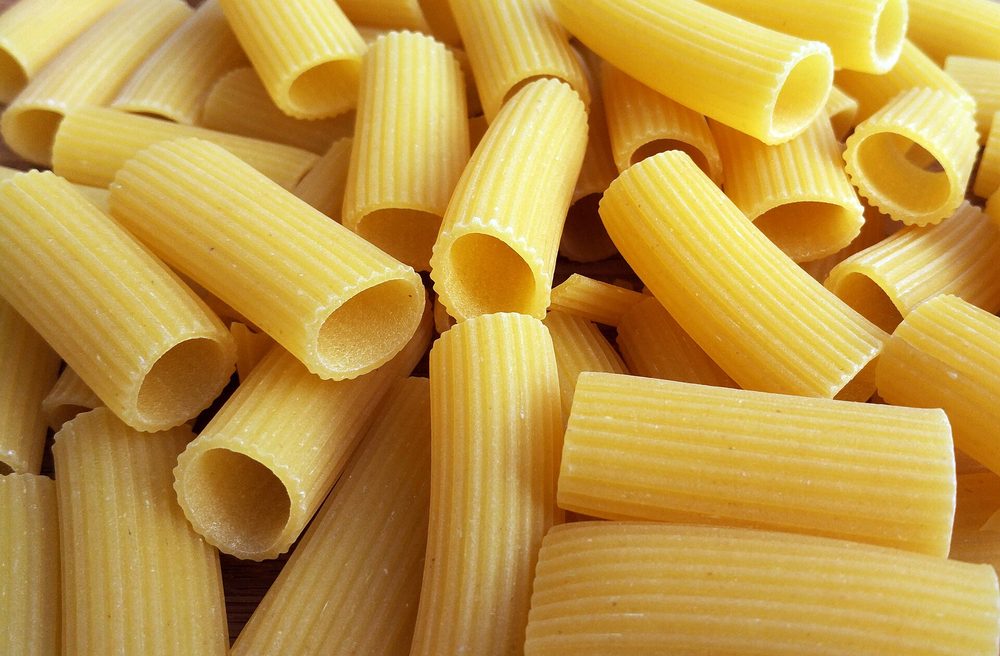
Fighter 1: Penne Rigate — The Beveled Hydrodynamic Dart
Penne, named after the Latin penna (quill), mimics the writing tip of a fountain pen. Its iconic 45-degree angle of attack is not merely decorative; it serves as a hydrodynamic scoop. As the fork plunges through a sauce matrix, the beveled aperture presents an elliptical cross-section with an increased surface area compared to a flat cut, theoretically facilitating fluid entry.
The fluid dynamics of penne, however, are double-edged. When suspended in a low-viscosity emulsion, the angled ends create a convergent nozzle. Under motion, sauce drawn into the lumen experiences a pressure differential (the Venturi effect) that can accelerate liquid straight out the rear aperture rather than trapping it.
Where Penne Rigate claws back momentum is its external ridge network. The fine helical striations increase the functional boundary-layer surface area by roughly 22% compared to smooth penne lisce. As starch gelatinises at 60°C to 68°C, amylose leaches from these exterior peaks into the cooking water. When finished in the pan (saltata), these ridges serve as physical anchor points for suspended lipid droplets, stabilizing the butter- or oil-based phase of an emulsion against the pasta wall.
Fighter 2: Rigatoni — The High-Capacity Wide-Bore Cylinder
Step into the ring with rigatoni, and you immediately confront pure volumetric dominance. Featuring a blunt, 90-degree orthogonal cut and a cavernous internal bore rarely dipping below 11.5 millimeters, rigatoni abandons fluid deflection entirely in favor of uncompromised capture.
The key to rigatoni’s payload efficiency lies in its internal and external architecture. Externally, deep parallel ridges (righe) create dramatic macro-grooves that disrupt fluid shear. More critically, the wide lumen acts as a low-velocity settling chamber. In fluid mechanics, when a particulate-laden slurry enters a wide pipe from a high-shear environment, flow velocity drops dramatically. This induces what food scientists term sedimentary entrapment: browned minced meat, sheared pancetta, and micro-globules of rendered fat migrate inside the tube and remain sequestered, protected from the scraping shear of the fork and plate.
Because rigatoni features thicker walls (typically 1.35 mm or greater), it retains structural rigidity across an extended thermal window. While penne’s thin, tapered quills risk collapse under structural load, rigatoni maintains an open cylinder that refuses to pancake beneath the weight of heavy, collagen-rich sauces.
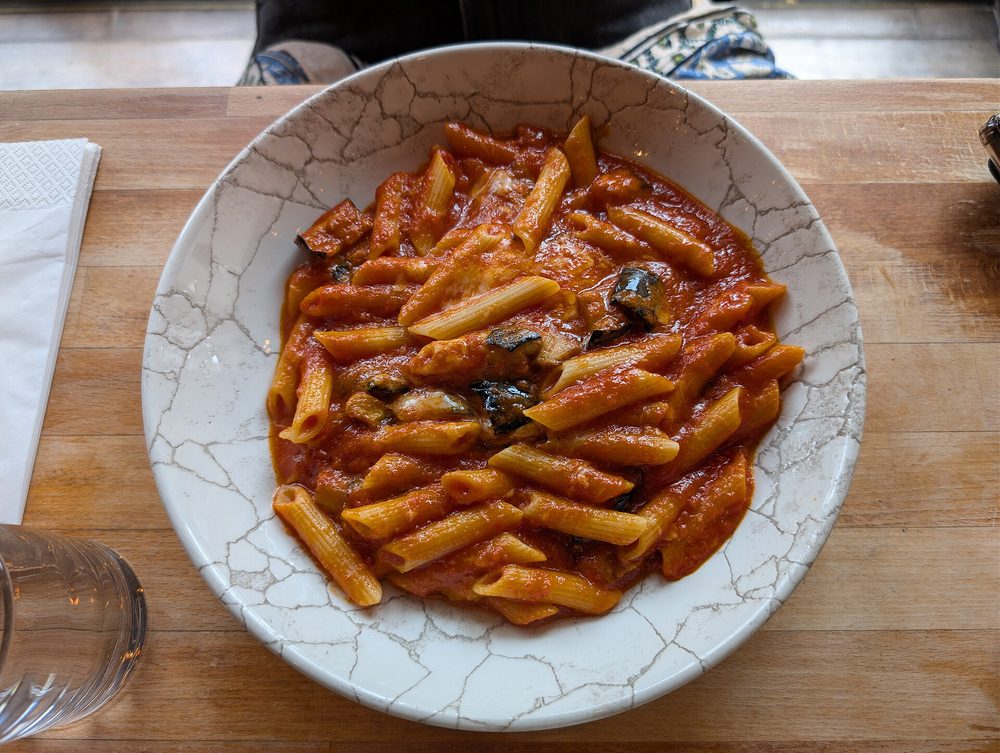
Fluid Mechanics: Capillary Rise, Viscosity, and Emulsion Stability
Sauce retention relies on two distinct mechanisms: capillary action within the lumen and surface-tension adhesion on the exterior. Capillary rise is inversely proportional to the tube’s radius. By pure physics, penne’s narrower lumen generates slightly higher theoretical capillary pressure than rigatoni’s wide bore. In thin broths or watery emulsions, penne should pull liquid upward more eagerly.
However, culinary sauces are not Newtonian fluids like pure water; they are non-Newtonian pseudoplastic fluids. Under shear (tossing in the pan), their apparent viscosity drops; at rest on the fork, their viscosity surges.
Capillary Pressure Equation:
ΔP = (2 * γ * cos θ) / r

Where:
γ = Interfacial surface tension (oil-water-starch interface)
θ = Contact angle (governed by surface roughness from bronze dies)
r = Tube radius (Lumen)
Because rigatoni has a significantly larger radius ($r$), the capillary pressure drop is modest, meaning thick emulsions do not rely on capillary draw. Instead, rigatoni operates via mechanical obstruction. When sauce enters the wide cavity, the high internal surface area—combined with gelatinised amylose traps—creates a viscous drag boundary layer. The sauce does not just adhere to the wall; it locks together as a cohesive internal core.
Penne’s acute cut creates an irregular meniscus. The sloping tip exposes sauce directly to gravity and lateral shear before it reaches the mouth, allowing emulsions with lower yield stress to break free and pool uselessly on the ceramic.
Scientific Pitfalls: How Each Contender Fails in the Sauté Pan
Neither fighter is immune to catastrophic failure modes when mismanaged over high heat.
The Collapse of Penne
Penne’s fatal flaw is its geometric vulnerability at the bevel. The acute, paper-thin tips hydrate and gelatinise exponentially faster than the central cylindrical body. By the time the central core achieves al dente mastication (target: 20–25% ungelatinised core protein matrix), the tips are frequently overcooked. These weak points fold inward under pan shear, crimping the lumen shut and transforming an open tube into a flattened, starch-welded strap completely incapable of internal sauce intake.
The Rigatoni Blowout
Rigatoni fails through incorrect hydration and thermal shocking. Due to its massive wall thickness, cooks who employ insufficient water volume or aggressively violent boiling create a severe cross-sectional hydration gradient: over-gelatinised exterior versus brittle, chalky interior. If thrown prematurely into high-shear pan agitation, rigatoni suffers longitudinal stress fractures along its deep exterior ridges. The tube splits along its striations, unrolling into a curved sheet and instantly surrendering its prime mechanical advantage: volumetric entrapment.
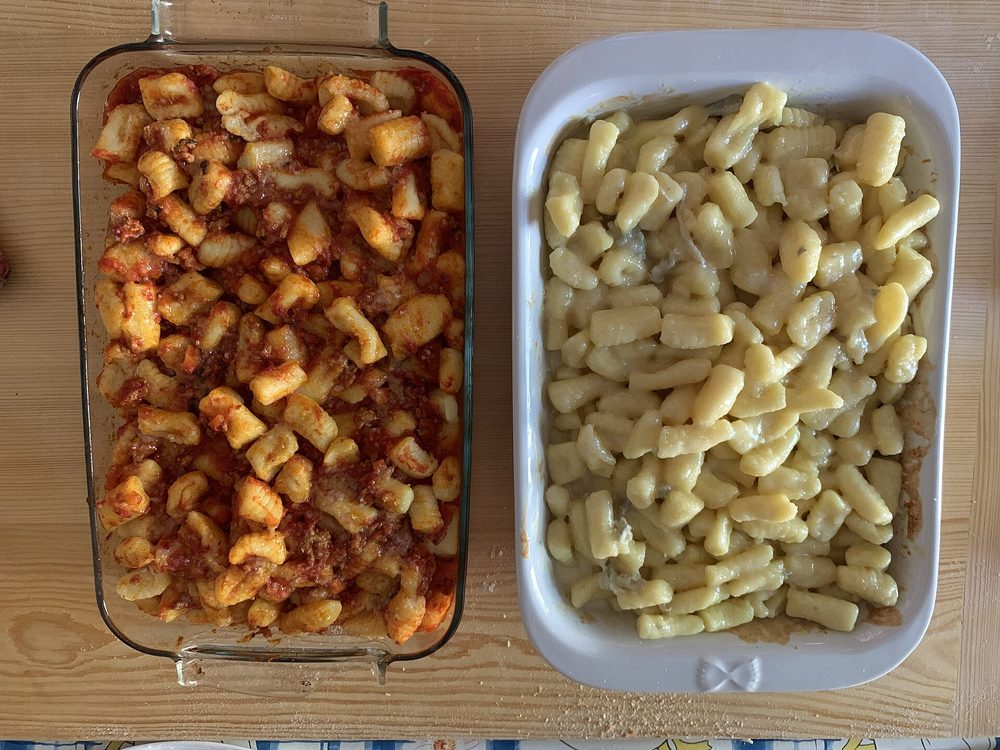
The Sauce Matrix: Ragù vs. Emulsified Silks
To observe these fighters under direct fire, we tested both shapes against two radically different culinary matrices: a coarse, collagenous Ragù alla Bolognese (high suspended solids, multi-phase lipid suspension) and a pristine Sugo all’Amatriciana (high-viscosity starch-guanciale emulsion with tomato solids).
Test 1: Ragù alla Bolognese
Penne struggled immediately with solid-phase particulates. Beef and pork mince ground to standard 4.5 mm plates repeatedly clogged penne’s intake or were deflected entirely by the angled quill. Penne coated nicely with the lipid slick on its exterior ridges, but delivered an embarrassingly low payload of meat to the palate. Rigatoni, by contrast, operated like a dragnet. Its wide internal chamber swallowed multiple clumps of ragù per piece, achieving near-perfect stoichiometric balance between durum wheat chew and savory protein delivery.
Test 2: Sugo all’Amatriciana
In the emulsion trial, penne mounted a fierce counterattack. Its exterior surface-area-to-mass ratio allowed the starch-thickened tomato-lipid matrix to cling tenaciously to the exterior helical grooves. Yet even here, rigatoni held the baseline: the internal vacuum effect of the large bore drew in the unctuous, pecorino-emulsified tomato sauce, holding it firmly without dripping. When bitten, rigatoni produced a hydraulic burst of pressurized sauce that penne’s narrow profile simply could not match.
The Arbiter’s Final Verdict
Penne Rigate is an engineering marvel designed for swift travel through medium-viscosity purees, but its tapered geometry is ultimately its undoing. The angled cut creates a variable hydration profile, structurally weak tips that collapse under heavy pan tossing, and an entrance aperture prone to particulate exclusion.
Rigatoni is the unyielding king of tubular dynamics. Its perpendicular cut guarantees uniform hydration across the entire perimeter, while its expansive internal lumen acts as a high-capacity reservoir for both complex emulsions and heavy structural solids. By marrying robust boundary-layer friction on the outside with an unbeatable particulate trap on the inside, rigatoni delivers superior sauce payloads per bite across virtually every operational parameter. Put penne back in the cupboard; when sauce needs to be conquered, deploy the wide bore.